Why flood insurance in Nebraska deserves serious attention
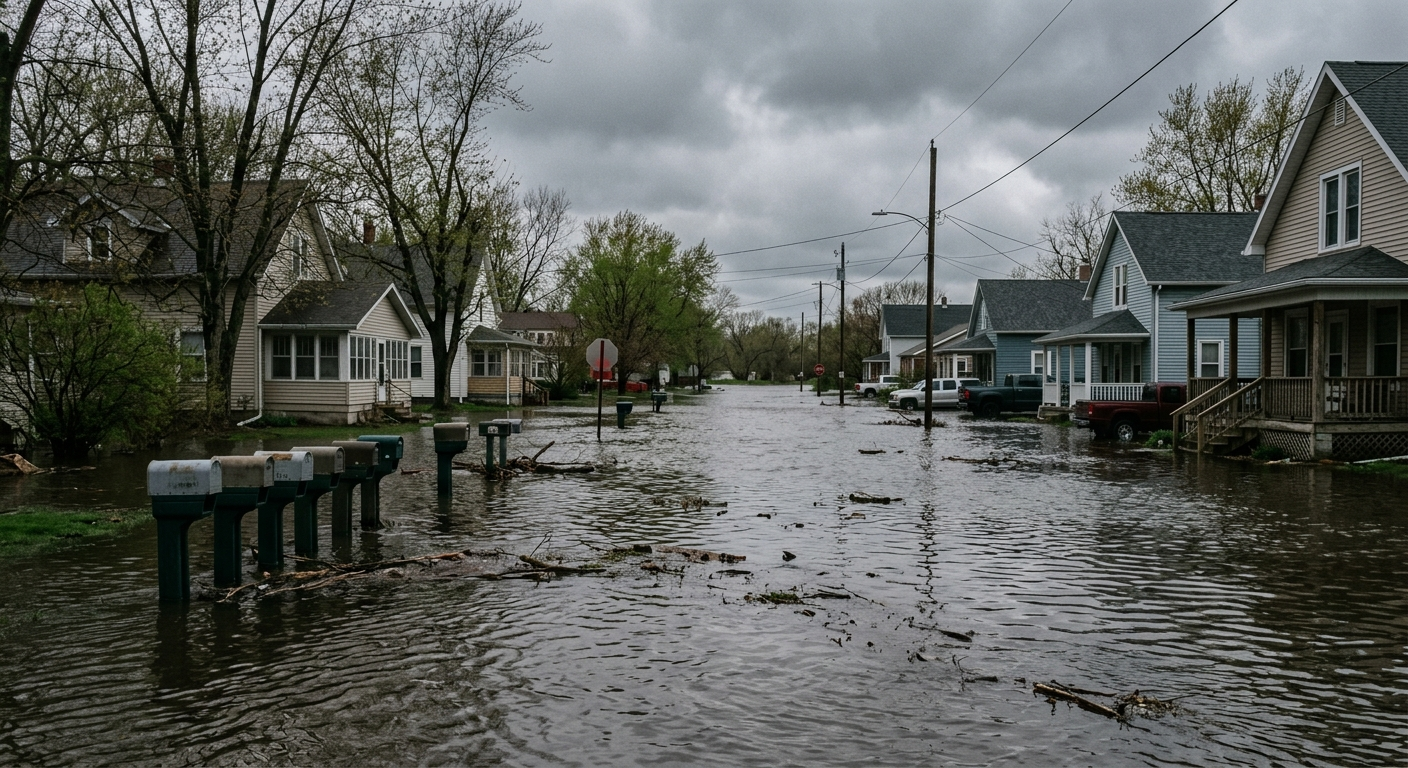
Flood insurance in Nebraska is one of the most overlooked gaps in a homeowner's coverage. Most people assume their standard homeowners policy covers water damage from rising rivers, overflowing creeks, or heavy spring runoff. It does not. Flood damage is specifically excluded from virtually every homeowners policy in the country, and Nebraska's geography makes that exclusion a real financial risk for tens of thousands of residents.
Nebraska sits at the convergence of multiple major river systems: the Missouri, the Platte, the Loup, and the Elkhorn, along with dozens of smaller tributaries. Communities from Fremont to Fort Calhoun to Tekamah have experienced significant flood events within the last decade. The March 2019 "bomb cyclone" flooding caused an estimated $1.4 billion in losses across Nebraska, with entire towns temporarily isolated and thousands of homes damaged or destroyed. Many of those homeowners had no flood coverage at all.
This post breaks down how flood insurance works in Nebraska, compares the two main options (the federal NFIP and private flood carriers), explains what each one covers and where each falls short, and helps you figure out which is the better fit for your home or business.
What standard homeowners insurance does not cover
Before getting into flood-specific policies, it is worth being clear about the gap. Your homeowners insurance covers a lot of water-related damage, but only under specific circumstances. It typically covers sudden and accidental water damage from inside the home, such as a burst pipe or an appliance leak. What it does not cover is water that originates outside your home and enters from the ground up.
FEMA defines a flood as "a general and temporary condition of partial or complete inundation of two or more acres of normally dry land area or of two or more properties." That definition captures:
- Overflow from rivers and streams , the Platte and Elkhorn have both caused widespread property damage in recent years
- Storm surge and heavy rainfall runoff , particularly in low-lying areas or neighborhoods near retention ponds
- Mudflow , which is technically covered under the NFIP flood definition when it originates from a flood event
- Flooding from a blocked or overwhelmed drainage system , common in older communities with aging municipal infrastructure
None of these events trigger coverage under a standard homeowners policy. If you want protection, you need a separate flood policy. And if you are in a federally designated high-risk flood zone, your mortgage lender likely requires one.
How the NFIP works in Nebraska
The National Flood Insurance Program, managed by FEMA, is the most widely known source of flood coverage in the country. Nebraska has over 130 communities that participate in the NFIP, which means homeowners and renters in those communities can purchase a federally backed flood policy.
NFIP coverage basics
NFIP policies come in two parts, sold separately or together:
- Building property coverage up to $250,000 for the structure itself, covering the foundation, electrical and plumbing systems, HVAC equipment, built-in appliances, and permanently installed flooring and cabinets
- Personal property (contents) coverage up to $100,000 for your belongings, including furniture, clothing, electronics, and portable appliances
Renters can buy contents coverage only. Condo owners can buy contents coverage and, in some cases, unit coverage depending on their association's master policy.
What NFIP does not cover
The federal program has notable gaps that catch people off guard at claim time:
- Additional living expenses (ALE) : NFIP will not pay for a hotel or temporary housing if flooding makes your home uninhabitable.
- Basements : contents stored in basements are largely excluded, and coverage on basement improvements and mechanicals is limited.
- Detached structures : garages, sheds, and outbuildings are not covered under NFIP residential policies.
- Landscaping, decks, and fences : not covered.
- Vehicles : your car requires comprehensive auto coverage for flood damage, not a flood policy.
The 30-day waiting period
One of the NFIP's most significant drawbacks is the standard 30-day waiting period before a new policy takes effect. If there is a named storm or flood event in the forecast and you do not already have coverage, it is almost certainly too late. There are narrow exceptions (such as when a new purchase is being closed), but for most homeowners, coverage purchased during an emergency warning period will not apply to that event.
NFIP costs in Nebraska
FEMA's Risk Rating 2.0 system, fully implemented in 2022, replaced the old zone-based pricing with property-specific risk assessments. Premiums now reflect the actual flood risk at your specific address, considering factors like flood frequency, flood type, and the cost to rebuild your home. For Nebraska homeowners not in mapped high-risk zones, annual NFIP premiums can run anywhere from roughly $500 to $1,200 per year for a typical residential building policy. Properties in higher-risk zones along the Missouri River corridor or in flood-prone communities along the Platte will see higher rates.
Private flood insurance: how it compares
Private flood insurance has expanded over the last several years as more carriers have entered the market with sophisticated flood modeling tools. For many Nebraska homeowners, a private policy now offers broader coverage at a competitive price. Here is how private flood stacks up against the NFIP.
Coverage advantages private flood often provides
- Higher coverage limits : private policies frequently offer structural limits well above the NFIP's $250,000 cap, which matters if your home's rebuild value exceeds that threshold.
- Additional living expenses : many private flood policies include ALE, so you are not paying out of pocket for temporary housing.
- Basement contents coverage : some private carriers offer more generous treatment of below-grade spaces.
- Detached structures : often included or available as an endorsement.
- Shorter waiting periods : some private carriers offer coverage effective in as little as 10 to 14 days, though this is still not immediate.
Potential downsides of private flood
- Non-renewal risk : private carriers can decide not to renew a policy after a high-claims year or if their own modeling changes. NFIP is backed by the federal government and cannot drop you.
- Lender acceptance : most lenders will accept a private flood policy as satisfying the mandatory flood purchase requirement, but confirm this with your lender before switching.
- Pricing volatility : private premiums can shift more dramatically year to year based on market conditions.
Which option is right for you?
There is no universal answer. If your home is in a designated high-risk flood zone (AE, VE, or similar) and your lender requires coverage, private flood can satisfy that requirement and may offer better terms than the NFIP. If your home is in a moderate- or low-risk area, a private policy's lower entry cost and broader benefits often make it the better choice. Comparing both options side by side is where an independent agent earns their value.
Nebraska-specific flood risks by area
Nebraska's flood exposure is not uniform. Your risk depends heavily on where you live relative to river systems, soil type, topography, and local drainage infrastructure.
Missouri River corridor
Communities along the Missouri River, including Blair, Fort Calhoun, and Tekamah, face some of the most direct flood exposure in the state. The 2011 Missouri River floods inundated farmland and structures for months. FEMA flood maps in this corridor show extensive AE and X zones, and property values here require careful attention to coverage limits.
Platte River communities
Fremont has been particularly hard-hit. The March 2019 flood effectively surrounded the city for days, requiring evacuations and causing widespread damage. The Platte River system also affects Valley, North Bend, and communities in Dodge and Saunders Counties. Even properties not directly adjacent to the river can see flooding from saturated soils and overwhelmed drainage when significant snowmelt and rain arrive simultaneously, which is exactly what happened in 2019.
Elkhorn River basin
The Elkhorn River drains a large portion of northeastern Nebraska. Communities like Hooper, Snyder, and West Point have all seen notable flooding events. Downstream toward Waterloo and Valley, the Elkhorn converges with the Platte, creating a zone where multiple flood sources can combine.
Low-risk does not mean no-risk
About 25% of all NFIP flood claims nationwide come from properties outside of high-risk flood zones. If you are in a Zone X (moderate or minimal hazard), you are not immune, especially in Nebraska where intense summer thunderstorms and rapid spring snowmelt can overwhelm drainage systems quickly. Coverage in lower-risk zones tends to be considerably cheaper, so the cost-to-protection ratio is quite favorable.
Flood insurance for Nebraska businesses and landlords
Commercial property owners face the same coverage gap that residential homeowners face: standard commercial property policies almost universally exclude flood. If your business sits near a river, creek, or low-lying area, that exclusion can be financially devastating.
NFIP offers commercial flood insurance with structural limits up to $500,000 and contents limits up to $500,000 . For many small businesses, that ceiling is adequate. For larger operations, excess flood coverage from private markets may be necessary to fully protect building value and equipment.
Landlords should also consider that flood damage to a rental property can create a period of lost rental income while repairs are made. Private flood carriers sometimes include loss of rents coverage; the NFIP does not. Pairing a landlord policy with appropriate flood coverage is worth discussing with your agent. If you are evaluating your overall commercial coverage picture, the guide on Nebraska homeowners insurance is a useful starting point for understanding how different policy layers work together.
Common questions about flood coverage in Nebraska
Does my homeowners insurance cover sewer backup from flooding?
Sewer backup is not the same as flooding, and neither standard homeowners policies nor NFIP flood policies automatically cover it. Some homeowners policies offer a sewer or drain backup endorsement as an add-on, which is relatively inexpensive and worth having. However, if the sewer backup is a direct result of a flood event, coverage can get complicated, and it is worth asking your agent how your specific policy handles it.
I am not in a flood zone. Do I still need coverage?
FEMA flood maps are updated periodically, and they reflect historical data rather than future risk. They also do not capture all types of flooding. In Nebraska, overland flooding from saturated ground, overwhelmed storm drains, or back-to-back severe storms can affect properties that have never flooded before. The low cost of coverage in a minimal-risk zone makes it a reasonable purchase for most Nebraska homeowners.
Can I use my NFIP policy at an Airbnb or short-term rental?
NFIP policies do cover residential properties used as short-term rentals, but the contents coverage is limited and the policy does not address lost rental income. If you own a short-term rental property, discuss the full picture with your agent to make sure your flood, property, and liability coverage all align.
How do flood claims work?
Under the NFIP, claims are filed through your Write-Your-Own (WYO) carrier or directly with NFIP. An adjuster is assigned to inspect and document the damage. Payment is based on actual cash value for contents and replacement cost or ACV for the building depending on the policy. Private flood claims go through the private carrier. In either case, thorough documentation (photos, video, an inventory of damaged items) speeds the process considerably.
Get the right flood coverage with Eric Luebbe Insurance Agency
At Eric Luebbe Insurance Agency , we are an independent agency, which means we are not locked into one carrier or one program. We can compare both NFIP options and private flood markets to find coverage that fits your home, your location, and your budget. Whether you are in Fremont near the Platte River, along the Missouri River corridor near Blair, or in a low-risk area where you want protection at an affordable premium, we will walk you through the numbers and the tradeoffs so you can make an informed decision.
Flood damage is one of the most expensive and disruptive events a Nebraska homeowner can face, and the right policy in place addresses that risk before it becomes a financial crisis. Do not wait for a storm warning to start asking questions.
Call us at (402) 721-5454 or reach out online to get a flood insurance quote and see what coverage looks like for your specific property. We are here to help you protect what you have built.