What inland marine insurance covers in Nebraska
Inland marine insurance in Nebraska is one of those coverages most business owners have never heard of until the day they need it. If your company moves tools, equipment, materials, or goods from one location to another, your standard commercial property policy almost certainly leaves a coverage gap the moment that equipment hits the road. Inland marine fills that gap. For contractors, electricians, plumbers, landscapers, and equipment rental companies across eastern Nebraska, that gap can be the difference between a minor setback and a serious financial hit.
The name is misleading. "Inland marine" has nothing to do with boats or oceans. The term dates back to policies that covered goods shipped overland after ocean transit ended. Today it refers broadly to property that moves, is stored off-site, or is too specialized for a standard property form to handle correctly. Think of it as a floater policy for your business: coverage that follows your property wherever it goes.
Covered causes of loss typically include theft, fire, vandalism, accidental damage, and certain weather events. The exact triggers depend on the form, but most inland marine policies are broader than the named-peril structure of a basic commercial property policy.
Who needs inland marine coverage in Nebraska
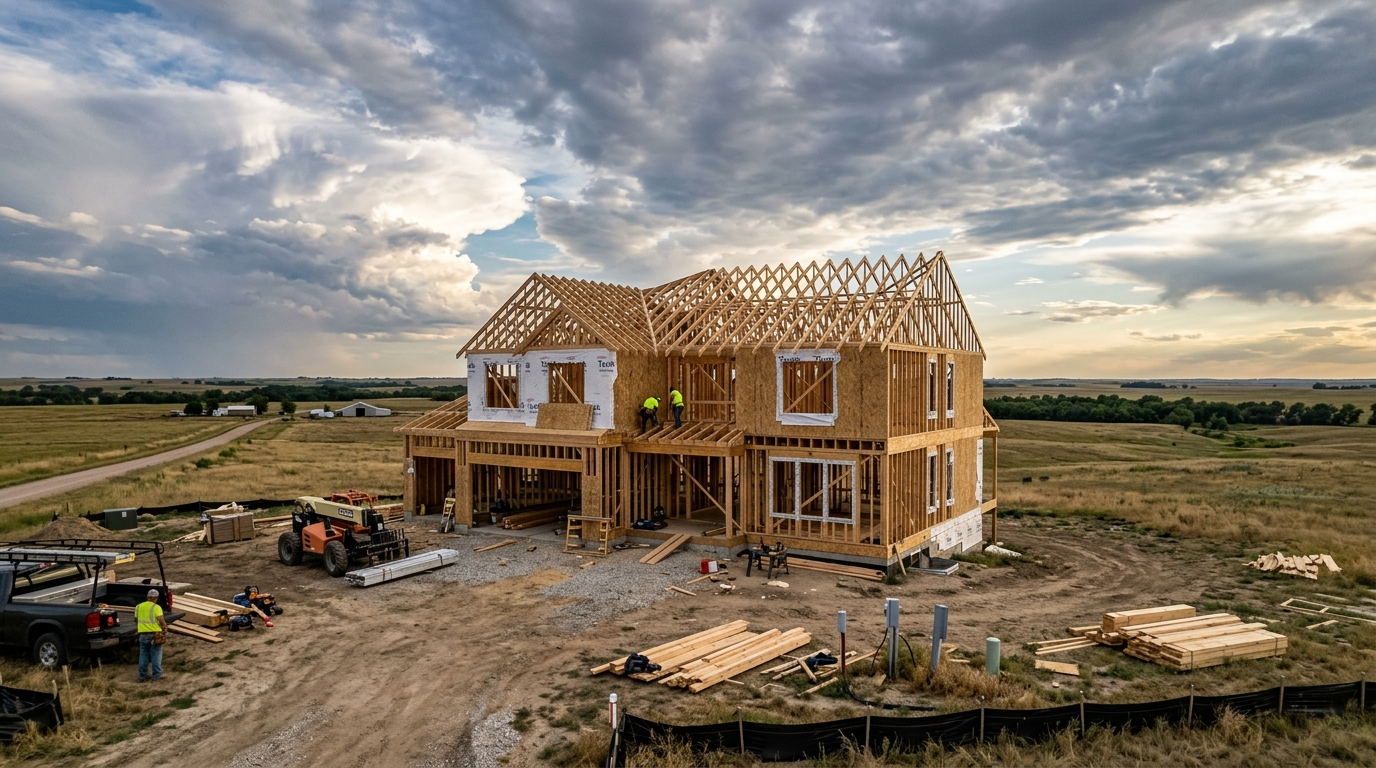
Nebraska's construction and trades industries are busy. From residential buildouts around Fremont and Blair to commercial projects in the Omaha metro, crews are hauling expensive gear across the state every day. Any business that fits one of the following profiles should evaluate inland marine coverage.
- General contractors and subcontractors. Equipment and materials move from yard to job site constantly. A stolen skid steer or a load of lumber damaged in transit is not covered by a standard property policy while it is in transit or on a third-party site.
- Electricians, plumbers, and HVAC technicians. Tools and specialty equipment are often left in a work van or on a job site overnight. Standard auto policies do not cover tools stored in the vehicle, and commercial property policies stop at the front door of your listed premises.
- Landscapers and excavators. Mowers, compact track loaders, and attachments move from property to property. Each stop creates a coverage gap that inland marine closes.
- Equipment rental companies. When you rent equipment to others, you need coverage that follows the machine to whatever job site the renter takes it to.
- Photographers and media production companies. Cameras, lighting rigs, and audio gear are expensive and mobile. A camera floater or equipment floater under an inland marine policy is the right tool for this exposure.
- Fine art dealers and auction houses. Artwork in transit or on loan to galleries carries unique valuation challenges that inland marine forms handle better than standard property forms.
- Retail businesses with goods in transit. If you ship or receive inventory, a cargo inland marine policy covers goods moving between locations.
If you are a Nebraska contractor who has not yet reviewed your full coverage picture, our post on Nebraska contractors insurance is a solid starting point before you dig into inland marine specifics.
Inland marine vs. commercial property: understanding the gap
Many business owners assume their commercial property policy covers their equipment no matter where it is. That assumption is costly when it turns out to be wrong.
A standard commercial property policy covers property at a scheduled, fixed location . Once your tools leave your shop or your materials leave your yard, they typically fall outside the scope of that policy. Some forms include a small off-premises sublimit, often $10,000 or less , which sounds helpful until you realize that a single compact excavator can cost $50,000 or more.
Commercial auto insurance covers the vehicle itself and liability related to its operation. It does not cover the tools, equipment, or materials inside or on the truck. That is a separate exposure entirely.
Inland marine sits in between. It covers property while it is in transit, while it is at a job site that is not your primary business location, and in some cases while it is stored temporarily at a third-party facility. That mobility is the defining feature of the coverage.
A quick comparison:
- Commercial property policy. Covers equipment and inventory at your listed address. Coverage typically stops at the property line.
- Commercial auto policy. Covers the vehicle and driving-related liability. Does not cover cargo or tools inside the vehicle.
- Inland marine policy. Covers equipment, tools, and materials while they are moving, at job sites, or stored off-premises.
Common inland marine forms used by Nebraska contractors and trades
Inland marine is not a single standardized form. Carriers use different forms depending on what type of property is being covered. The following are the most common types you will encounter in Nebraska's construction and trades sectors.
Contractors equipment floater
This is the most common inland marine form for contractors. It covers owned, borrowed, and rented equipment while it is at job sites, in transit, or stored temporarily. Coverage applies on a scheduled basis (each piece of equipment listed with its own value) or a blanket basis (a total limit shared across all covered equipment). Blanket coverage is simpler to manage but requires an accurate total value. Underinsuring equipment on a blanket form creates a coinsurance problem at claim time.
Installation floater
An installation floater covers materials and equipment waiting to be installed at a job site. Once a contractor delivers HVAC units, cabinets, or plumbing fixtures to a site, those materials are at risk from theft and weather before they are incorporated into the building. An installation floater covers that gap. This is different from builders risk insurance, which covers the structure under construction as a whole. Both may be needed on larger projects.
Tools and small equipment floater
Smaller tools under a certain value threshold (often $1,000 to $2,500 per item ) are typically not worth scheduling individually. A tools floater covers these items on a blanket basis. For electricians or plumbers whose vans carry $15,000 or more in hand tools and power tools, this coverage is a straightforward, affordable way to close a real gap.
Cargo/transit coverage
If your business moves goods between locations as part of normal operations, cargo or transit coverage protects those goods while they are on the road. This is common for distributors, retailers taking delivery of inventory, and businesses that ship finished goods to customers.
Miscellaneous floaters
Carriers also offer inland marine forms for fine art, medical equipment, musical instruments, scientific equipment, and other specialized property categories. The common thread is that the property has unique valuation needs or moves frequently enough that a standard property form is a poor fit.
How inland marine claims work and what affects the payout
Understanding how claims are settled matters as much as having the coverage. Two valuation methods are common in inland marine policies, and the difference can be significant.
Actual cash value (ACV) pays what the equipment was worth at the time of the loss, after depreciation. A four-year-old generator that cost $8,000 new might only get you $3,500 under an ACV settlement. That gap comes out of your pocket if you need to replace it with a new unit.
Replacement cost value (RCV) pays what it actually costs to replace the item with a comparable new one. This is the better option for most contractors, though it carries a higher premium. The premium difference is usually modest compared to the difference in claim outcome.
A few other factors that affect claims:
- Scheduled vs. blanket coverage. Scheduled items need accurate, current appraisals. If you added a new piece of equipment and forgot to add it to the schedule, it may not be covered at all.
- Deductibles. Inland marine deductibles are often set per occurrence, not per item. Read the policy language carefully to understand what you will owe before coverage applies.
- Exclusions. Mechanical breakdown, normal wear and tear, and mysterious disappearance (loss without a clear cause) are common exclusions. Some carriers offer buybacks for mysterious disappearance on higher-tier forms.
- Proof of ownership and value. Keeping a current equipment inventory with purchase receipts and photos speeds up the claims process considerably. Store that inventory somewhere other than the job site.
What inland marine insurance costs in Nebraska
Premiums vary widely because the covered property varies so much from one business to the next. A sole-proprietor electrician with $20,000 in tools has a very different risk profile than a general contractor with $500,000 in equipment across multiple job sites.
General cost factors include:
- Total insured value. More equipment means higher premium. Accurate values matter here; underinsuring to save on premium backfires at claim time.
- Type of equipment. Equipment that is easy to steal (compact, high-value, in demand on the used market) carries higher rates than large, hard-to-move machinery.
- Where you operate. Businesses that regularly work in areas with higher theft rates may face higher premiums. Nebraska's rural job sites can carry lower theft risk than urban ones, which sometimes works in a contractor's favor.
- Security measures. GPS tracking on equipment, locked storage, and alarm systems can reduce premium. Carriers want to know what steps you take to protect equipment overnight.
- Claims history. A history of frequent small theft claims will push your premium up and may limit carrier options.
- Deductible selected. A higher deductible lowers the annual premium. The right balance depends on your cash flow and risk tolerance.
For a small contractor in Nebraska, a basic tools and equipment floater might run $500 to $1,500 per year . A mid-size contractor with $250,000 or more in covered equipment could see premiums in the $2,000 to $5,000 range or higher , depending on the factors above. Getting quotes from multiple carriers is the most reliable way to find competitive pricing for your specific situation.
Pairing inland marine with the rest of your commercial coverage
Inland marine does not stand alone. It works best as part of a coordinated commercial insurance program that closes all the gaps rather than just shifting them.
Most Nebraska contractors and trades businesses need at least the following:
- General liability. Covers bodily injury and property damage to third parties caused by your operations. This is the baseline requirement for most contracts and licenses. Our post on general liability for Nebraska small businesses covers the requirements and cost factors in detail.
- Commercial auto. Covers your work vehicles and driving-related liability. Nebraska requires minimum liability limits for commercial vehicles, and those minimums are rarely enough for a serious accident involving a loaded work truck.
- Workers compensation. Required in Nebraska for most employers with one or more employees. Protects your crew and limits your business's lawsuit exposure when a worker is injured on the job.
- Inland marine. Covers your equipment and materials while they are moving or at job sites.
- Builders risk. If you are building or substantially renovating a structure, a builders risk policy covers the structure itself during construction. Inland marine covers the equipment doing the work; builders risk covers the work being done. See our full breakdown of builders risk insurance in Nebraska for more detail on how these two coverages interact.
Some carriers will package general liability and inland marine together, which can simplify administration and reduce overlap or gaps. An independent agent can review your full exposure and identify where a package makes sense versus where separate policies give you better terms.
Get the right inland marine coverage for your Nebraska business
If your business moves equipment, tools, or materials across eastern Nebraska, there is a real chance you have a coverage gap right now. Inland marine insurance is straightforward once you understand what it does, and an independent agent can get you quoted across multiple carriers quickly to find the best fit for your operation.
Eric Luebbe Insurance Agency is an independent agency serving contractors, tradespeople, and small business owners across Fremont, Blair, Dodge, Elkhorn, Gretna, and the surrounding communities. Because we work with multiple carriers rather than being tied to one, we can compare coverage options and pricing to find the policy that fits the way your business actually operates.
Call us at (402) 721-5454 or reach out through our contact page to talk through your equipment and operations. We will help you figure out exactly what coverage you need, what you can skip, and what the right limits look like for your business size and risk profile.